
WELCOME BONUS 300%
UP TO €2000 + 100
FREE SPINS
UP TO €2000 + 100
FREE SPINS
Home → Blackjack
Blackjack at 10black: Variants, Rules and Payouts
Insurance vs Even Money on Own Blackjack
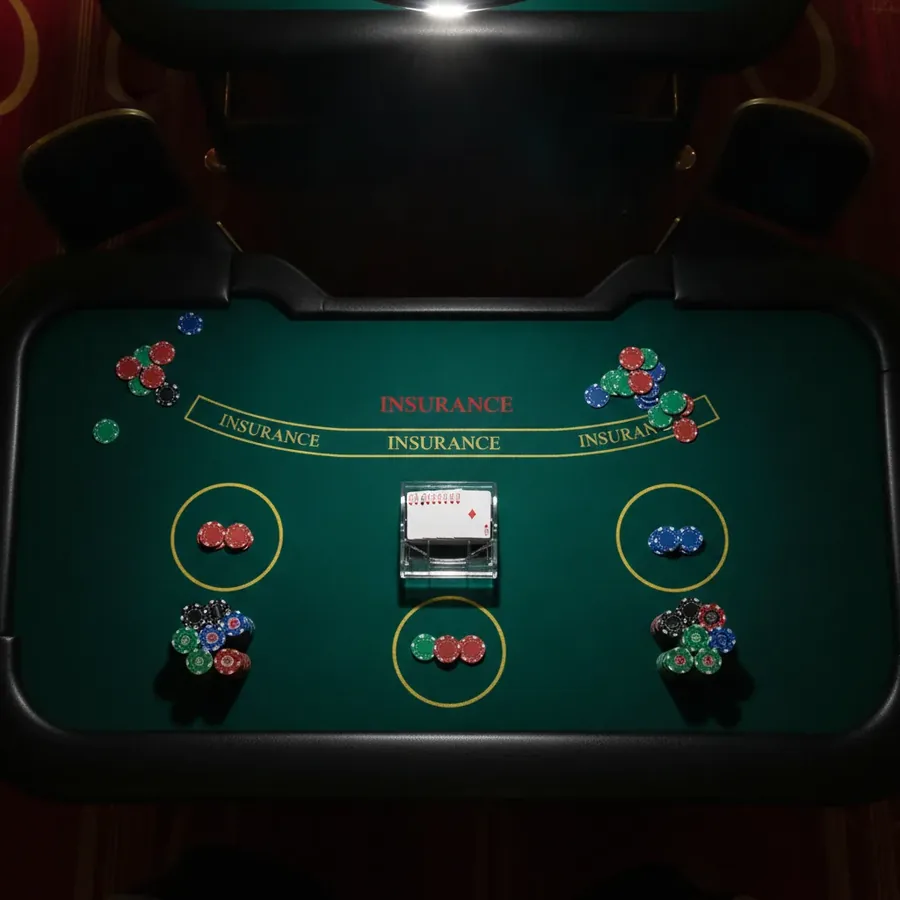
Blackjack Insurance, offered when the dealer shows an Ace, allows a side bet up to 50% of the main wager, paying 2:1. With a house edge of 7.47% in a 6-8 deck game, this side bet is designed to be consistently unfavorable.
However, the RTP for Blackjack Insurance drops to 92.53%, a significant deviation from standard blackjack play. Basic strategy dictates always declining this bet unless card counting indicates a true count of +3 or higher, where it might become marginally advantageous.
Opting out of Insurance when the dealer shows an Ace, and instead adhering to optimal strategy, preserves the player's capital for the main hand. This decision is particularly crucial in single-deck variations where the house edge on Insurance can increase to approximately 5.88%.
What Percentage Does Blackjack Count Towards Bonus?
The wagering requirement for the 300% welcome bonus up to €2,000 is affected by game contribution rates. Table games, including all blackjack variants, contribute only 10% towards fulfilling these wagering conditions.
This means that for every €100 wagered on blackjack, only €10 will count towards the total turnover. To illustrate, achieving a €2,000 bonus from a 300% offer would require a substantial €4,000 in turnover from blackjack alone due to this reduced contribution.
Conversely, slots contribute 100% towards bonus turnover, meaning a €100 wager on slots counts as a full €100 towards the wagering. This disparity makes clearing bonus funds significantly more efficient via slot gameplay.
Ignored Basic Strategy Chart: 1 Percent Wasted
Choosing to ignore basic strategy on a Blackjack game with classic rules and a 3:2 payout can significantly increase the house edge. While the base RTP is a favourable 99.85% with a 0.15% house advantage in such a scenario, deviations have consequences.
For example, the Blackjack Auszahlung 6:5 variant, where payouts are 6:5 instead of the traditional 3:2, directly adds 1.39 percentage points to the casino's advantage, pushing the RTP down to 98.15%. This rule change is more impactful than most others.
Deviating from established optimal play, such as not adhering to basic strategy in a Blackjack 6 Decks game with S17, DAS, DOA, and a 3:2 payout, results in a higher house edge. The cited RTP for this specific configuration is 99.54%, but suboptimal play increases the house advantage beyond the calculated 0.46%.
Step-by-step Split at the Live Table
At the live tables, specifically Infinite Blackjack by Evolution, players can split their hands when dealt two cards of the same rank. This action allows a player to create two separate hands from the initial two cards, each with its own subsequent play.
Following a split, the player places an additional bet equal to the original wager for the new hand. The dealer then deals a second card to each of the split hands, and play continues on each hand independently according to standard blackjack rules.
Double After Split (DAS) is a rule that can further enhance gameplay, allowing players to double down on their hand after splitting cards. While not explicitly detailed for every live table variant, its inclusion can improve the player's RTP by approximately 0.14 percentage points.
What doesn't count towards turnover at 10 percent?
Games that do not contribute fully to bonus wagering requirements are a crucial consideration for players. In this casino's offering, all table games, including various blackjack and poker options, are stipulated to contribute only 10% towards the turnover.
This means that for every €1 wagered on a table game, only €0.10 is counted against the total wagering requirement. Therefore, a player aiming to clear a substantial bonus amount will find progress significantly slower when focusing solely on these game types.
Consequently, while live blackjack tables like Infinite Blackjack and Quantum Blackjack Plus Live offer engaging gameplay, their contribution to bonus turnover remains at the 10% threshold. This contrasts sharply with slots, which contribute 100% of wagers.
Blackjack variants at a glance
| Variant | Payout | House edge | Rule | Bet range |
|---|---|---|---|---|
| Blackjack Insurance / Versicherung (6–8 Decks) | 92.53% | 7.47% | Separate Nebenwette bis 50% der Hauptwette, wenn der Dealer ein Ass hat. Basisstrategie schreibt IMMER Ablehnung vor (außer Karten zählen bei True Count ≥ +3). Bei einem Deck Vorteil ≈ 5.88% | Insurance 2:1 |
| Blackjack Auszahlung 6:5 statt 3:2 (6 Decks) | 98.15% | 1.85% | Ersatz von 3:2 durch 6:5 fügt exakt +1.39 Prozentpunkte zum Vorteil des Casinos hinzu – stärker als jede andere Regeländerung. Bei $10 Einsatz zahlt Blackjack $12 statt $15. | Blackjack 6:5, Gewinn 1:1 |
| Blackjack Ein Deck, klassische Regeln, 3:2 | 99.85% | 0.15% | Weniger Decks = niedrigerer Vorteil; ein Deck gibt ca. −0.48 Prozentpunkte gegenüber 8 Decks. Oft durch 6:5 Auszahlung kompensiert. | Blackjack 3:2, Gewinn 1:1 |
| Blackjack Liberal Vegas Strip (liberale Regeln, 3:2) | 99.72% | 0.28% | Günstigste Regelkombination: S17 + DAS + Resplit + Late Surrender. Standardabweichung 1,15 | Blackjack 3:2, Gewinn 1:1 |
| Blackjack 6 Decks, S17, DAS, DOA, Auszahlung 3:2, Basisstrategie | 99.54% | 0.46% | Dealer steht auf Soft 17; Verdopplung auf jeder Zweierkarte; Verdopplung nach Split erlaubt; keine Aufgabe. Basisstrategie ist für diesen Wert zwingend | Blackjack 3:2, normaler Gewinn 1:1, Insurance 2:1 |
| Blackjack Surrender (Late Surrender) – Regel-Effekt | n.a. (Regel-Modifikator) | −0.08 Prozentpunkte | Spieler gibt Hand nach Dealer-Blackjack-Prüfung auf, verliert die Hälfte des Einsatzes. Verbessert RTP um ca. 0.08 Prozentpunkte. Early Surrender ist wesentlich wertvoller (bis −0.6 Prozentpunkte), aber extrem selten. | Rückzahlung 50% des Einsatzes |
Side Bets Increase House Edge to 5 Percent
Side bets, such as those offered in Infinite Blackjack, can significantly alter the house edge. While Infinite Blackjack itself boasts an RTP of 99.47%, its four side bets (Any Pair, 21+3, Hot 3, Bust It) introduce a higher house advantage.
For instance, Blackjack Insurance, when offered with 6-8 decks, carries a house edge of 7.47%. This is substantially higher than the base game's edge, meaning more of the player's wager is retained by the casino over time.
Choosing to participate in these side wagers means the effective house edge for the entire hand can climb considerably. For a player focused on maximizing return, these side bets should generally be avoided, as their RTP can drop as low as 92.53%.
Bonus Lost Due to 10 Percent Contribution
The 300% welcome bonus up to €2,000 at this casino has specific wagering requirements that impact how players can clear it. Notably, table games, which include Blackjack variants, only contribute 10% towards the wagering requirement.
This means that for every €100 wagered on Blackjack, only €10 counts towards fulfilling the bonus conditions. To illustrate, achieving a €2,000 bonus would require a total turnover of €20,000 if playing exclusively slots (100% contribution).
However, if a player primarily engages with Blackjack, the required turnover to clear the same €2,000 bonus increases to €200,000 (€2,000 bonus / 10% contribution * 100). This significantly extends the time and amount of play needed to realize the bonus funds.
Bonus conditions often exclude Blackjack completely
While the 300% welcome bonus up to €2,000 has a 10% contribution for table games, some casino bonuses outright exclude Blackjack from contributing to wagering requirements entirely.
This means that any wagers placed on Blackjack variants, regardless of the specific rules like S17 or DAS, would not count towards clearing the bonus. Players would then need to rely on other game categories, such as slots, to meet the bonus terms.
Exclusions are a critical aspect of bonus terms and conditions. It is essential for players to carefully review these conditions to understand which games contribute and to what extent, especially when considering a game like Blackjack Liberal Vegas Strip with its low 0.28% house edge.
Soft 17: Dealer Hits or Stands
The rule concerning whether the dealer hits or stands on a soft 17 significantly impacts the house edge. In Blackjack 6 Decks, where the dealer stands on soft 17 (S17), the house advantage is 0.46%.
Conversely, if the dealer hits on soft 17 (H17), as is the case in Blackjack Split / Double / H17, this rule modifier increases the house edge by 0.22 percentage points. This means the player's theoretical return is reduced.
For example, a player at a Blackjack 6 Decks table where the dealer stands on soft 17 faces a lower house edge compared to a similar game where the dealer hits on soft 17. This difference, while seemingly small, affects the long-term expected outcome.
Which table limits suit 20 EUR balance?
A player with a €20 balance would need to select tables with very low minimum bet limits to prolong their gameplay. Many live dealer options have higher entry points, such as Infinite Blackjack and Quantum Blackjack Plus Live, both starting at €1,000.
Blackjack Party offers a slightly lower entry point, with bets from €1.00 to €1,000. However, even a €1 minimum bet on a €20 balance means only 20 hands can be played theoretically, without considering any losses.
To make a €20 balance last longer in a game like Blackjack 6 Decks, which has a 0.46% house edge, a bet of €0.50 or less would be ideal. Such low stakes are often found at RNG-based blackjack tables rather than live dealer options.
Seat change at the Live Table in 20 seconds
Infinite Blackjack, provided by Evolution, offers unlimited player seats at its live tables. This feature ensures that players do not have to wait for a seat, regardless of how many people are playing. The game allows wagers ranging from 1 EUR to 5,000 EUR per hand.
This approach to table capacity contrasts with traditional live blackjack, where a limited number of physical seats can lead to player queues. Infinite Blackjack's design aims to maximize player engagement by removing common waiting times. The game also incorporates four distinct side bets: Any Pair, 21+3, Hot 3, and Bust It.
The theoretical return to player (RTP) for Infinite Blackjack is stated at 99.47%. This figure suggests a low house edge when optimal strategy is applied, making it an attractive option for players prioritizing frequent returns. The ability to always find a seat contributes to a more fluid gaming session.
How many decks are in the shoe?
Blackjack Insurance, a side bet available in games typically using 6 to 8 decks, has a notably high house edge of 7.47%. The RTP for this specific wager stands at 92.53%. This bet is offered when the dealer's upcard is an Ace.
A single-deck Blackjack variant, adhering to classic rules with a 3:2 payout, offers a superior RTP of 99.85% and a house edge of just 0.15%. The reduction in decks, from 8 to 1, contributes approximately 0.48 percentage points to a lower house advantage.
Standard live blackjack games often employ multiple decks, such as the 6-deck variant featuring S17, DAS, DOA, and a 3:2 payout, which has a house edge of 0.46% with an RTP of 99.54%. The number of decks directly influences the game's overall house edge.
How long does a Live Blackjack round take?
While specific round duration for all live blackjack variants is not detailed, the Infinite Blackjack game by Evolution is designed for continuous play with unlimited seats. This setup aims to minimize downtime between hands, ensuring players can participate without significant delays. The focus is on providing an uninterrupted gaming flow.
Blackjack Party, also from Evolution, emphasizes a social atmosphere with two hosts, suggesting a more relaxed pace than purely strategic games. The interaction with hosts and other players might extend the perceived duration of a round, though the actual card play remains a core element.
Quantum Blackjack Plus Live from Playtech incorporates 'Quantum Multipliers' of up to 1,000x on specific combinations resulting in 21 points. The inclusion of these special features and potential multiplier payouts might influence the overall time a round feels like it takes, even if the core gameplay remains standard.
Chose Wrong Table for 5 EUR Bankroll
A player with a 5 EUR bankroll might find many tables unsuitable if minimum bets exceed this amount. For instance, Infinite Blackjack and Quantum Blackjack Plus Live have a minimum bet of 1 EUR, but side bets or rapid play could deplete a small bankroll quickly. The wager range at these tables is 1 EUR to 5,000 EUR.
The Blackjack Payout 6:5 instead of 3:2 significantly increases the house advantage by 1.39 percentage points, raising it to 1.85% with an RTP of 98.15%. A player betting 5 EUR on a 6:5 payout Blackjack would receive 6 EUR instead of 7.50 EUR from a 3:2 payout, a substantial difference for a small stake.
The house edge on Blackjack Insurance is notably high at 7.47%, with an RTP of 92.53%. Betting 5 EUR on this side bet when the dealer shows an Ace carries a substantial risk of loss, making it unsuitable for a conservative bankroll management strategy. This bet is generally advised against for most players.
Blackjack Payout 3:2 Explained in Detail
A 3:2 payout in Blackjack means that for every 2 EUR wagered, the player receives 3 EUR in winnings, in addition to their original stake. This is the standard and most favorable payout for a natural Blackjack (an Ace and a ten-value card on the initial two cards).
In contrast, a 6:5 payout for Blackjack reduces the player's return significantly. For a 2 EUR bet, a 6:5 payout yields only 2.40 EUR in winnings, whereas a 3:2 payout would grant 3 EUR. This difference adds approximately 1.39 percentage points to the casino's advantage.
The RTP for Blackjack with a 3:2 payout and classic rules, especially when played with fewer decks like a single deck (RTP 99.85%, house edge 0.15%), is considerably higher than variants with less favorable payouts. For example, a 6-deck game with S17, DAS, DOA, and 3:2 payout still offers a strong RTP of 99.54%.
Contact
Live - online chat
Banking









Providers












10Black Casino 2026